
Angel investors are high-net-worth individuals who invest their own money into early-stage startups in exchange for equity. They are often ex-founders or seasoned industry operators who know how hard zero-to-one can be. If you’ve ever typed “what are angel investors” into a search bar while wondering where to find that crucial first cheque, you’re in the right place.
There’s a notorious “valley of death” between building a prototype and having enough traction for institutional funding. Banks rarely lend to pre-revenue startups. Grants help, but don’t usually cover full commercialisation. Angels step into that gap, sharing risk with you because they believe in the team, the market, and the timing.
What angel investors do (beyond the money)?
Beyond writing cheques, angel investors coach founders, make customer and hiring introductions, help with strategy and fundraising, and provide accountability to keep you moving towards milestones. Here’s a detailed look at what their role entails:
Mentorship and operator know-how
Angels have scars and shortcuts. Expect practical guidance on pricing, hiring your first salesperson, scoping an MVP, or framing your first enterprise pilot. Good angels are sounding boards when decisions are messy.
High-value introductions
Warm intros are currency. Angels unlock:
- Customers and pilots (your first lighthouse account)
- Talent (fractional CTOs, early sales leaders, specialist contractors)
- Co-investors (follow-on funds, grant programmes, corporates)
Accountability and governance
You won’t inherit a heavy board at pre-seed, but angels help you set cadence like monthly updates, KPIs that matter, and milestone discipline, so you stay fundable.
Signalling and follow-on
Credible angels are a quality signal to later investors. Some will follow their money if you’re hitting milestones, which will strengthen your next round.
Do I need revenue to get angel investment?
You don’t always need revenue to get angel investment. Many pre-seed rounds close pre-revenue, but you’ll need credible proof MVP, pilots, usage, or letters of intent that customers care and that your plan is capital-efficient.

What’s the difference between Angel investors vs venture capital?
Angels invest personal money earlier, and often work closely with you. VCs invest from funds, typically at later stages with larger cheques and more structured governance. Many startups raise angels first, then VC once traction strengthens.
How does angel investing work?
Founders typically pitch to individual angels or networks, complete light due diligence, and raise via equity or instruments like an ASA/convertible. UK angels often invest under EIS (Enterprise Investment Scheme) / SEIS (Seed Enterprise Investment Scheme), which offers tax relief, so getting advance assurance early helps.
It’s important to note that angel investors do take a percentage of equity in return for their investment. Round-level dilution at pre-seed/seed commonly sits at around 10-20%, though it does vary by traction, market and round size.
Raising funds from angels can typically take anywhere from a few weeks to a few months. Speed depends on your readiness (deck, data room, clarity), how aligned investors are, and whether EIS/SEIS paperwork is underway.
Here’s the typical journey leading to investment:
1) Sourcing and screening
You’ll typically apply to an angel group/network (like Minerva Business Angels) or meet angels through warm introductions and events. Screening checks the basics: team, market, problem, early proof, and whether your round size and valuation make sense.
2) Pitching
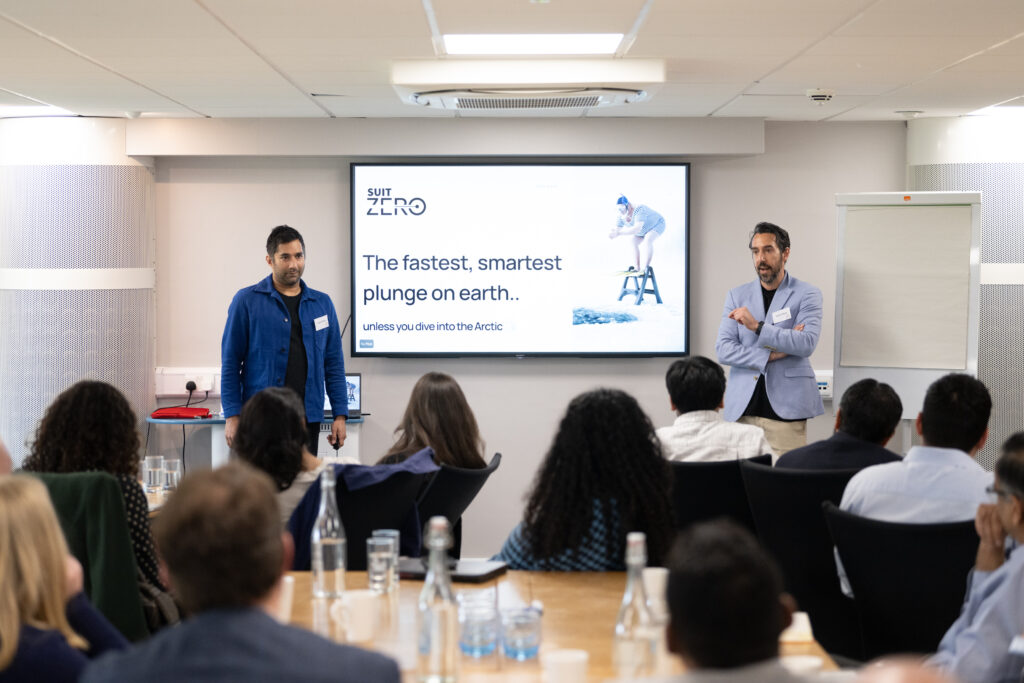
You pitch at a forum or in smaller meetings. Keep it crisp: problem, solution, market size, traction, business model, go-to-market, competition, team, use of funds, and a clear milestone plan for the next 12–18 months.
3) Due diligence
Expect questions about IP ownership, customer proof, financial model assumptions, regulatory considerations, and your cap table. A lightweight data room speeds this up: deck, product demo, contracts/LOIs, financials, incorporation documents.
4) Terms and instruments (UK context)
Common structures include:
- Ordinary or preference equity (priced round)
- ASA (Advanced Subscription Agreement) or convertible for speed and flexibility
- EIS/SEIS eligibility to give UK angels tax relief (very attractive—get your advance assurance early)
5) Completion and funds flow
Once terms are agreed and documents are signed, funds are transferred—often from multiple angels into a single round.
6) Post-investment partnership
Now the real work begins. You’ll share updates, ask for targeted help, and translate capital into traction.
Timelines can be anything from a few weeks to a few months, depending on readiness, round complexity, and how quickly you answer diligence questions.
Is angel investment right for you?
Angel investment fits best when:
- You’re tackling a large, painful problem with a credible route to scale.
- You have evidence of pull (MVP, pilots, letters of intent, early revenue, or strong engagement).
- Money will unlock specific milestones (e.g., productisation, key hires, regulatory step, first commercial pilots) within 12–18 months.
- You’re comfortable with equity dilution and aligned on building a high-growth company.

When it may not be right:
- Lifestyle businesses or local services without a scalable growth story
- Where grants or revenue comfortably fund the next steps
- If you want to retain 100% ownership indefinitely.
What angel investors look for
Whilst solo founders can still raise funding, investors are looking for a strong team that complements each other’s skill set. The market is also a big factor – timing matters. Show clear customer pain, credible TAM (Total Addressable Market) / SAM (Servicable Available Market), and why you can win.
Angel investors don’t just want a clever idea – they want proof that real people or businesses care about what you’re building. That proof is what they mean by “traction”.
Traction can look like pilot projects (a customer is testing your product in a limited way), LOIs (letters of intent where a customer says “we plan to buy this if X/Y happens”), paid trials (someone is already paying, even a small amount), or strong usage (lots of active users who keep coming back). All of these things signal that you’re not guessing. You’ve already started to find product–market fit.
If you’re doing something very technical or “deep tech”, investors will also want to see early signs that the tech really works. That might be patent filings (or at least having spoken to a patent attorney), lab or field tests, or external validation from experts. It reassures them that what you’re building is hard to copy and actually feasible.
How to prepare for an angel round
Essentials to have ready
- 10–12 slide deck focused on narrative and evidence
- 3-year financial model (sane assumptions, unit economics story)
- Data room basics: company docs, cap table, IP status, customer proof, product roadmap, security/regulatory notes if relevant
- Demo: short, real, problem–solution oriented
Valuation and dilution basics
At pre-seed/seed, founders typically sell 10–20% in a round. Anchor valuation to milestones you’ll reach with this capital, not best-case future scenarios.
Metrics that resonate
- Clear ICP and pipeline quality
- Sales cycle expectations and early conversion
- Gross margins and unit economics drivers
- Engagement/retention indicators if product-led
Update cadence and “asks”
Set the tone early: a simple monthly update with headline KPIs, what’s working, what’s not, and specific asks (customer intros, hiring, regulatory advice).
Spotlighting Minerva Business Angels at Warwick Science Park
Minerva Business Angels, part of the Warwick Science Park ecosystem, connects innovative founders with experienced angels who invest more than money. They invest time, networks and know-how. For founders building from the Midlands (and beyond), Minerva offers:
- Curated pitch opportunities to engaged angels across sectors
- Collaborative syndication, so rounds can come together efficiently
- Mentoring culture, operator-led advice and targeted introductions
- Integration with UWSP, including access to workshops, advisors and the wider innovation community
Who should consider applying?
The right candidates are early-stage companies looking for equity funding for growth or expansion. They must be able to show a clear route to market and evidence of demand, such as early sales or external validation. A credible management team is a must, along with a 5-year plan. It’s also a good idea to have an idea of how much you need to raise and how these funds will be spent.
What to expect from the process
Before you even click that ‘apply’ button, make sure you have a detailed business plan and a pitch deck that clearly explains your problem, solution, the market, your team and the financials.
Then, you can go ahead and register as an entrepreneur on the Minerva platform. This allows you to create an account where you can then submit and manage an application to pitch.
Once you’ve submitted your application, Minerva’s team will assess and be in touch to progress if you fit their criteria and present a good opportunity.
If you’re early in your journey, we can help you get investment-ready. Speak to our advisors to pressure-test your deck and data room. Drop an email to [email protected] – we’d love to hear from you.
Ready to apply to Minerva Business Angels? Head to the website to register and begin your application process.